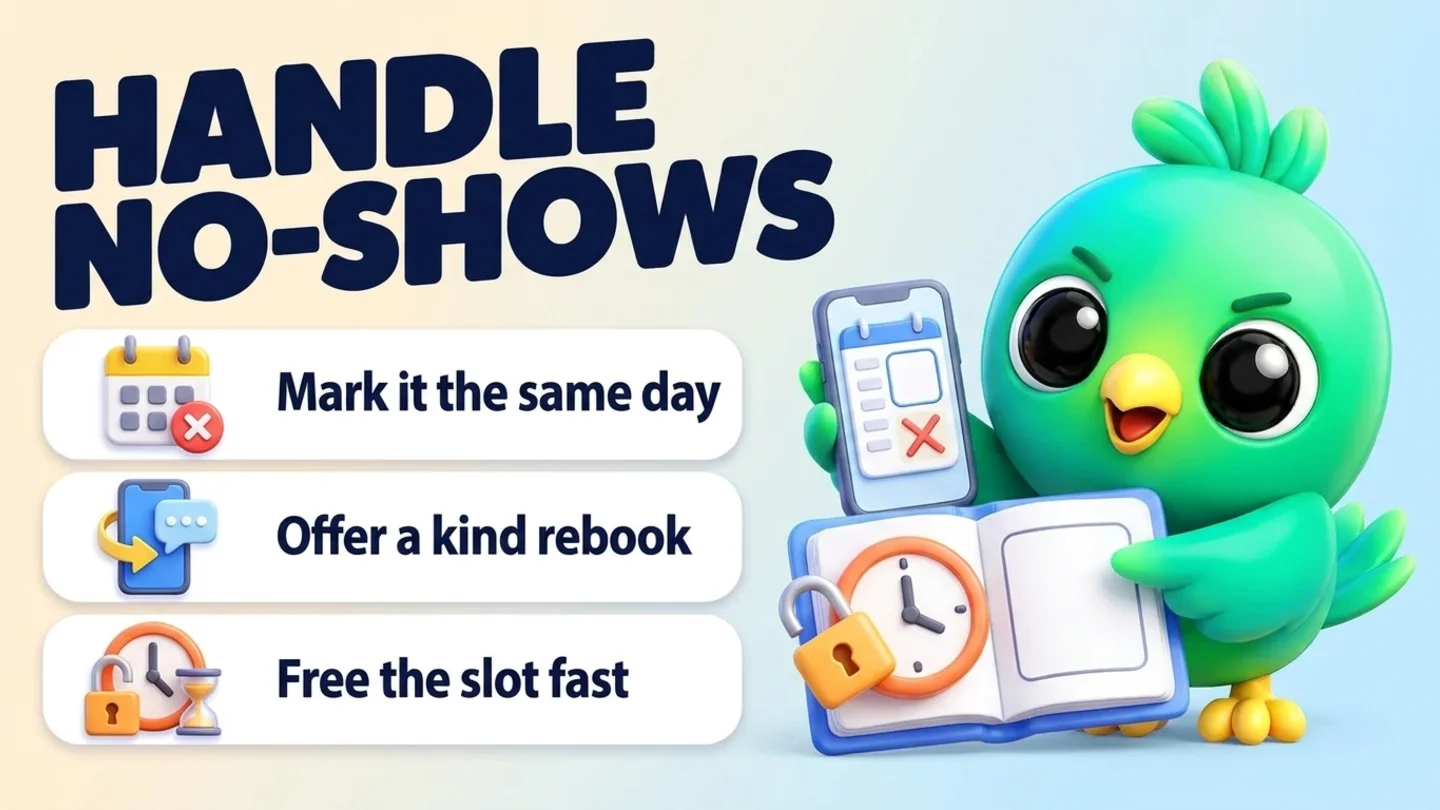
To handle an appointment no-show on WhatsApp without a bot, mark the chat as soon as you know they did not come, free the slot in your diary, and send one kind same-day message that assumes something came up rather than blaming them. Offer two specific new times (or a short booking link), then wait. If they stay quiet, send one gentle follow-up a few days later and stop. Write a one-line note so you can see who misses often. You do not need the WhatsApp Business API for this. You need a clear status, a short saved message and the discipline to close the loop the same day.
This post is part of our guide to WhatsApp CRM for small business. It covers what to do after someone misses a booked slot. For the normal booking loop (confirm, remind, close), see booking appointments on WhatsApp. If you take money up front so empty slots hurt less, taking a booking deposit on WhatsApp covers terms, payment links and what happens to the deposit. When a freed slot can go to someone else, running a waitlist on WhatsApp shows how to offer it fairly.
Last updated 16 October 2026. WhatsApp's Business Messaging Policy, WhatsApp Help Center pages and Meta's template categorization guidance were checked against each organization's own pages on that date. This is practical guidance, not legal advice. Your cancel and no-show terms must also follow the laws where you trade.
What counts as a no-show
Not every empty chair is a no-show. Name the situation so your message matches.
| Situation | What happened | First move |
|---|---|---|
| No-show | Booked, no cancel, did not arrive | Mark, free the slot, kind same-day check-in |
| Late cancel | Cancelled inside the notice you stated | Apply your cancel rule; free the slot; offer to rebook |
| Cancel with notice | Cancelled with enough notice | Thank them; free the slot; easy rebook door |
| Running late | Messaged that they are delayed | Decide whether to wait, shorten or move |
| You cancelled | You could not keep the slot | Apologize; offer a new time promptly |
This post focuses on true no-shows and late cancels where the customer already had a booked time with you. Cold leads who never booked belong in reactivating cold WhatsApp leads, not here.
When a same-day recovery is worth it
A recovery message costs a minute. It pays off when the relationship still matters and the slot was real.
| Situation | Worth a same-day message? | Why |
|---|---|---|
| Regular customer, first miss | Yes | Most people had a real reason; a kind note keeps them |
| First visit, high-value slot | Yes | Offer a rebook; decide later whether the next visit needs a deposit |
| They already paid a deposit | Yes, but keep money talk short | Apply the terms you already sent; point to rebook, not a debate |
| Third miss in a short span | Soft check-in once, then a clearer rule | Patterns need a note, not three angry chats |
| They asked you to stop messaging | No | Honour the stop; remove them from reminders |
| You only got a vague "maybe Thursday" | Not a no-show | Treat it as an open enquiry, not a booked miss |
Prevention still matters more than recovery. Clear confirms and one day-before reminder cut empty slots; that loop is in booking appointments on WhatsApp. Recovery is for the misses that still happen.
The no-show loop in five steps
- Mark it and free the slot. Change the stage the same day so your list stays true.
- Send a kind same-day check-in. Assume life got in the way; invite a rebook without guilt.
- Offer specific times. Two options beat "message me when you are free".
- Follow up once, then stop. One gentle nudge a few days later; then leave the door open without chasing.
- Record the pattern. Note the miss so deposits, waitlists and future rules stay fair.
Step 1: Mark it and free the slot
Do the diary work before you write the message. An open "Booked" list full of yesterday's misses is how you double-book next week.
- Move the chat to No-show (or Late cancel).
- Free the time in your calendar or paper diary.
- Write one line in notes: date, service, showed / no-show / late cancel, and whether a deposit applied.
- If you keep a waitlist, check whether anyone asked for that day or time.
Internal note (for you, not the customer)
No-show 16 Oct - color and cut 2 PM - first miss - slot freed - waitlist checked
If a deposit was paid, apply the cancel and no-show terms you already sent when they paid. Do not invent a new rule in the heat of the moment. The deposit playbook is in taking a booking deposit on WhatsApp.
A freed slot is also the moment to check your WhatsApp waitlist. Offer it with one stated rule (held with a deadline, small group first reply, or open link) and say plainly whether anything is held.
Where to keep the status:
| Where | Good for | Watch out for |
|---|---|---|
| Paper diary + chat memory | A handful of bookings a day | Easy to forget who you already messaged |
| Sheet | Many staff or locations | Copying from chat by hand |
| Lists (labels) in WhatsApp Business | A quick "No-show" marker | Cannot hold date, service or deposit detail |
| Pipeline stage + Notes | Seeing who missed beside each chat | Needs a short end-of-day glance |
WhatsApp's help page on labels says labels are now lists and the WhatsApp Business app allows up to 20 of them. A "No-show" list is a fine start. Once you need date, service and miss count next to the chat, WhatsApp labels vs a real CRM explains when lists stop being enough, and our free WhatsApp sales pipeline template gives you a sheet to adapt.
Step 2: Send a kind same-day check-in
Send after you know they are not coming, ideally the same day once the slot has clearly passed. Waiting a week teaches both of you to forget.
Tone rules:
- Assume something came up. Most no-shows are not rude.
- Do not ask "where were you?" or lecture about your time.
- Mention the missed slot once, then move to rebook.
- Give an easy out ("or tell me if you would rather I do not follow up").
- Keep money talk out of this message unless they already paid a deposit and you need one calm line that restates the shared terms.
Note: WhatsApp's Business Messaging Policy says you may only contact people who gave you their number and opted in to hear from you, and that you must respect any request to stop, on or off WhatsApp. A customer who booked with you in this chat is already in that conversation. Do not add them to a broadcast or marketing list because they missed a visit. WhatsApp's help page on complying with its business policies also says a customer messaging you first does not count as opt-in to future proactive messages outside what they agreed to.
Same-day check-in (no deposit)
Hi [name], we missed you today for [service] at [time]. Hope everything is OK. Would you like to rebook? I can do [option A] or [option B], or tell me another day that works. If you would rather I leave it, that is fine too.
Same-day check-in (deposit already paid)
Hi [name], we missed you today for [service] at [time]. Hope everything is OK. Per the booking terms we shared when you paid the deposit, the [amount] is kept for that slot. If you want a new time, reply here and I will show the next openings.
Late cancel (inside your free window)
Thanks for letting me know, [name]. I have released [date/time]. I can offer [option A] or [option B] when you are ready, or message me later.
Late cancel (outside the free window, with a deposit)
Thanks for the update, [name]. Per the terms we shared, the deposit is kept for a late cancel. I have freed the slot. Reply if you want to look at a new time.
Save each version as a quick reply so you are not typing while annoyed. WhatsApp's help page says the WhatsApp Business app stores up to 50 quick replies and that media is not supported in quick replies on WhatsApp Web or Desktop, so keep these as text. Our free WhatsApp message templates tool is handy for drafting variants.
Step 3: Offer specific times to rebook
"Message me when you are free" dumps the work back on a busy customer. Two concrete options make a yes easy.
Two options
I can do [day, date] at [time] or [day, date] at [time] for [service]. Which suits you better?
One option plus a link
I have [day, date] at [time] free for [service]. Reply YES to take it, or pick another time here: [booking link].
They need more notice
No rush. Tell me which days usually work and how much notice you need, and I will offer times that fit.
When they pick a time, send the same clear confirmation you use for any booking (service, date, time, place, optional deposit). Then schedule the usual day-before reminder. That confirmation and reminder wording lives in booking appointments on WhatsApp.
If the next visit is higher risk (first visit after a miss, peak date, long service), say any deposit rule before you lock the new slot, using the same terms style as your booking deposit routine. Do not surprise them after they say yes.
Step 4: One gentle follow-up, then stop
If they do not reply to the same-day note, wait a few days (three is a common default), then send one short nudge. After that, stop chasing that miss.
Gentle follow-up (about three days later)
Hi [name], just circling back in case my last note got buried. Still happy to find a new time for [service] if you want one. If not, no worries at all.
Then:
| Their reply | Your move |
|---|---|
| Picks a time | Confirm, remind, treat as a normal booking |
| "Not now" | Note it; leave the door open; do not keep pinging |
| Asks you to stop | Confirm you will stop; remove from reminders and waitlists |
| Silence after the follow-up | Stop. One open door in notes is enough |
Two messages about one missed visit is enough. More than that starts to feel like debt collection, and WhatsApp lists debt collection among services that may not use WhatsApp for Business. If months pass and they are simply cold, any later win-back belongs under reactivating cold WhatsApp leads, and only if they agreed to hear from you.
Step 5: Record the pattern
One miss is life. Three misses with no notice is a business rule problem.
| Record | Example | Why |
|---|---|---|
| Missed date and service | 16 Oct, color and cut 2 PM | Facts, not feelings |
| Type | No-show / late cancel / cancel with notice | So your next rule fits |
| Deposit applied? | Yes, kept / refunded / none | Stops arguments later |
| Recovery sent | Same-day + day-3 follow-up | Avoids double messaging |
| Outcome | Rebooked 22 Oct / stopped / no reply | Closes the loop |
| Miss count (recent) | 2 in 3 months | Flags who needs a deposit next time |
Keep the record short. Note the miss and the outcome, not a personality essay. Our post on where WhatsApp CRM data is stored explains why less personal data is easier to look after.
After a recovered visit goes well, keep private feedback and public review asks separate, as in collecting customer feedback and asking for Google reviews.
When to ask for a deposit next time
Use deposits to protect costly slots, not to punish people in the recovery chat.
| Pattern | Sensible next step |
|---|---|
| First miss, good history | Rebook normally; keep reminders clear |
| First visit that no-showed | Deposit or shorter hold on the next booking |
| Peak-date or long service miss | Deposit for peak and long slots going forward |
| Repeat misses | Deposit (or prepay) before you lock another peak slot |
| They always cancel with notice | No deposit needed; thank them and rebook |
State the rule when you offer the new time, not after they confirm. Full wording for terms, payment links and hold windows is in taking a booking deposit on WhatsApp. Never ask for full card, bank or ID numbers in chat; WhatsApp's Business Messaging Policy forbids asking people to share those sensitive identifiers.
Simple stages for no-show recovery
You can add these to a booking board, or keep No-show as an outcome stage next to Done.
| Stage | Meaning | Your next move |
|---|---|---|
| Booked | Confirmed visit ahead | Send the day-before reminder |
| Reminded | Reminder sent | Deliver the appointment |
| Done | They showed up | Close notes; rebook if useful |
| No-show | Missed without enough notice | Free slot; same-day check-in |
| Rebook offered | Recovery message sent | Wait for a pick or the one follow-up |
| Cancelled | Freed on purpose | Apply cancel terms; waitlist if useful |
Move the chat as soon as the status changes. For the wider sales board rather than a booking board, see managing WhatsApp leads without the API and the daily WhatsApp Web sales workflow.
Salons, coaches, groomers, cleaners and photographers feel empty slots most often; the industry pages for beauty salons, gym and fitness coaches, pet shops and services, cleaning services and photographers show how those trades run the rest of the chat.
Where InboxCRM fits
InboxCRM is a WhatsApp CRM Chrome extension for WhatsApp Web. It is not a multi-staff calendar, a payment processor or a waitlist app, and it does not know when someone fails to arrive. It helps when you already book in chat and want the miss, the rebook offer and the note beside the conversation, without the WhatsApp Business API.
- No-show stages on a board. Add stages such as Booked, Reminded, Done, No-show and Rebook offered, then move chats with "Move to stage" in the chat tools panel or right-click "Add to CRM stage…". A stage chip shows next to the chat in your chat list. The CRM pipeline guide shows the setup, or try the interactive pipeline tutorial first (fictional data; nothing is sent).
- Miss details in Notes. Write "no-show 16 Oct, first miss, deposit kept, follow-up due 19 Oct" in the Notes tab, with tags or custom fields if you want miss count in one place. See the chat tools panel guide.
- Recovery messages as quick replies. Save the same-day, deposit and day-3 versions once, then use "Insert into message box" and add the times before sending. See the quick replies guide.
- Day-3 follow-up timing. From an open chat, use "Schedule message" for the gentle follow-up so it is not forgotten. Chrome must be running with WhatsApp Web open at send time. Check the chat before it goes out if they already replied. The scheduling guide and scheduling tutorial walk through it.
- A nudge for you, not the customer. Notifications can remind you to "send no-show check-ins for today's misses" or "offer the freed 2 PM slot to the waitlist" with a Chrome notification and send nothing to the customer. See the notifications guide.
- Optional follow-up rule on No-show. A rule with "On funnel entry" can send one gentle follow-up after a delay, with "Stop if chat replied" and "Stop if chat changed stage" so rebooked chats skip it. Each rule sends to a chat only once. Follow-up rules are not paced by the campaign sending-safety layer, so keep them for real booking chats only. The follow-up guide and follow-up tutorial cover the controls.
Honest limits: InboxCRM does not watch your door or calendar for arrivals, does not apply deposit refunds and does not message your waitlist by itself. Scheduling and follow-up rules only run while Chrome is open with WhatsApp Web. CRM records stay in Chrome on your device (chrome.storage.local), not on an InboxCRM server, and they do not appear in the WhatsApp mobile app. InboxCRM is a single-user extension, not a shared team inbox. If that fits how you work, you can add InboxCRM to Chrome.
Mistakes that make no-shows worse
- Leaving yesterday in Booked. Your list stops meaning anything.
- Accusatory first messages. Shame does not rebook chairs.
- Chasing more than twice. Two touches about one miss is enough.
- Debating the deposit in anger. Restate the terms you already sent; stay calm.
- Broadcasting "we had a cancellation" to people who never asked. That is marketing and needs opt-in; see WhatsApp opt-in without the API and WhatsApp broadcast limits.
- Skipping the waitlist. An empty slot you already freed can still help someone who asked.
- No written cancel rule until after a miss. Say the rule when you take the deposit or confirm the booking.
- Asking for card numbers in chat. Against WhatsApp policy; use a hosted payment link.
Frequently asked questions
How do I follow up after a no-show on WhatsApp?
Mark the chat, free the slot, then send one kind same-day message that mentions the missed time once and offers two new options (or a booking link). If they stay quiet, send one gentle follow-up a few days later and stop.
Can I handle WhatsApp no-shows without the Business API?
Yes. With the WhatsApp Business app or WhatsApp Web you can update a stage or list, paste a saved reply and schedule a follow-up by hand. Booking bots and shared inboxes help when several staff share one diary or volume is high.
Should I charge a no-show fee in the recovery message?
Only if that fee was already part of terms the customer accepted before the visit (usually with a deposit). The recovery chat is for checking in and rebooking. Do not invent a new fee after the miss.
How soon should I message after a no-show?
The same day, once it is clear they are not coming. Same-day notes recover more bookings than a message sent a week later, and they free you to offer the slot to a waitlist while the time still matters.
What if the same person no-shows more than once?
Rebook if you still want the customer, but require a deposit or prepay on the next peak or long slot, and say that rule when you offer times. Keep a short miss count in your notes so the rule stays consistent.
Sources
- WhatsApp Business Messaging Policy (last updated 23 September 2026), WhatsApp, checked 16 October 2026
- How to comply with the WhatsApp Business Messaging and Commerce policies, WhatsApp Help Center, checked 16 October 2026
- How to use quick replies, WhatsApp Help Center, checked 16 October 2026
- How to use labels (labels are now lists), WhatsApp Help Center, checked 16 October 2026
- Template categorization, Meta for Developers, checked 16 October 2026
InboxCRM is a WhatsApp CRM for WhatsApp Web. Pipeline, notes, follow-ups and quick replies beside every chat, with your CRM data kept in your browser.
Add InboxCRM to Chrome