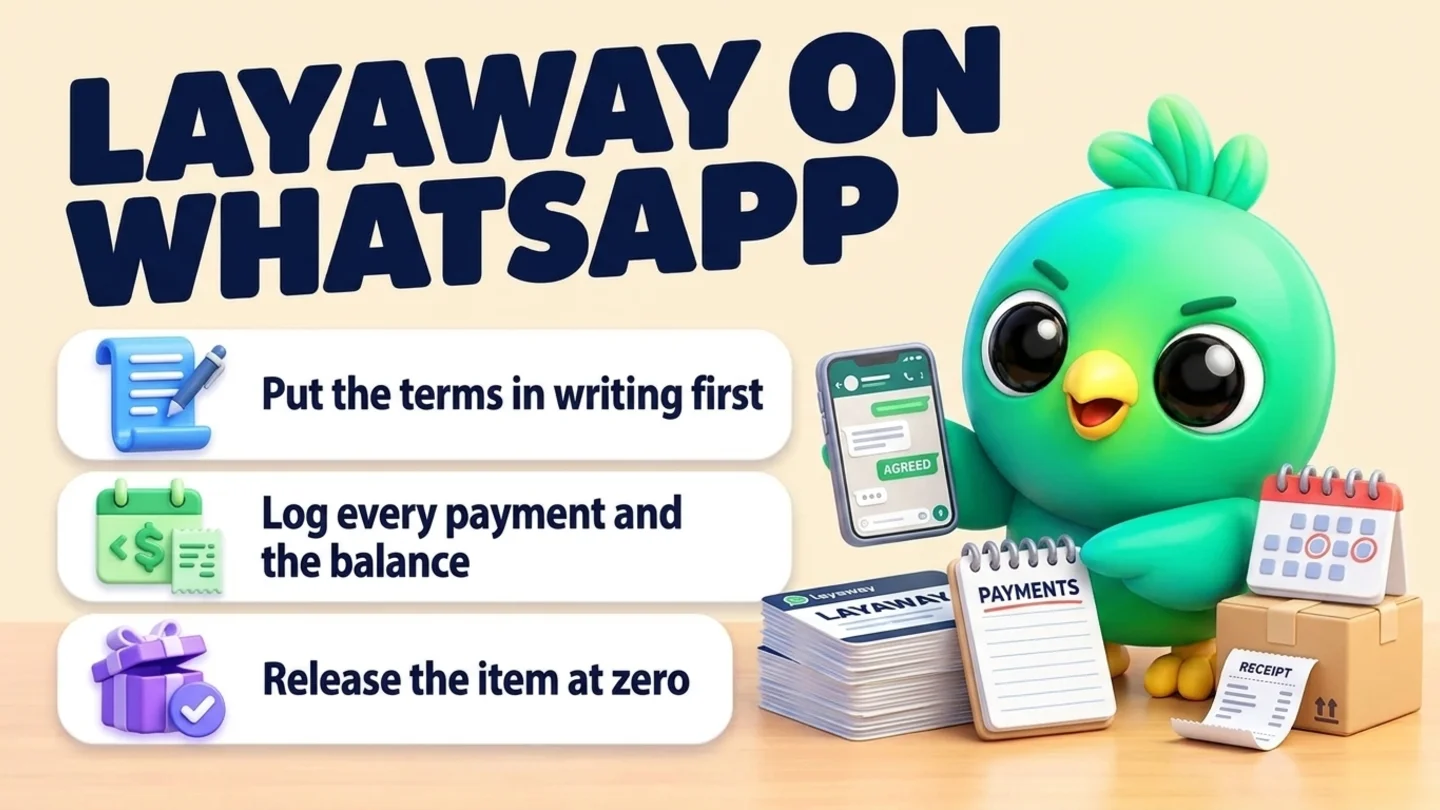
To run layaway on WhatsApp, write your layaway terms once (deposit, payment schedule, final due date, fees, what happens after a missed payment, refunds and pickup), then open each layaway with one written summary in the customer's chat: the item, the total price, the deposit, the schedule and the final date, which the customer replies YES to. Set the item aside only when the deposit shows in your own bank or payment account, send a short receipt with the new balance after every payment, remind the customer a few days before each due date, and hand over the item only when the balance is zero. This works in the free WhatsApp Business app or on WhatsApp Web, with no WhatsApp Business API and no point-of-sale add-on. The two things that cause most layaway disputes are terms that were never written down and balances that live only in someone's memory.
This post is part of our guide to WhatsApp CRM for small business. It covers a specific item that already exists, held for one customer while they pay it off in installments: a coat, a ring, a bike, a stroller, a holiday gift. Selling a batch before it is made is a different job, covered in taking pre-orders on WhatsApp. Holding an appointment slot with money is covered in taking a booking deposit on WhatsApp, and chasing an invoice that is already due is covered in WhatsApp payment reminders.
Last updated 28 October 2026. WhatsApp's Business Messaging Policy, New York General Business Law section 396-t, California Civil Code sections 1749 to 1749.4 and the CFPB's official interpretation of Regulation Z section 1026.2(a)(14) were checked against each organization's own pages on that date. This is practical guidance, not legal advice.
Layaway is not a pre-order, a hold or a payment plan
Customers use these words loosely, so it helps to know which one you are offering before you write the terms.
| What you offer | What the customer gets | When they get the item | Typical example |
|---|---|---|---|
| Layaway | A specific item set aside while they pay in installments | Only after the last payment | "Pay this coat off over 6 weeks, pick it up when it is paid." |
| Free hold | A specific item kept for a short time, no money taken | When they come in and pay in full | "I can keep it behind the counter until Saturday." |
| Pre-order | A place in a batch that does not exist yet | When the batch is ready | "Holiday cookie boxes, pickup 23 December." |
| Payment plan or financing | The item now, money later | Immediately | "Take it today, pay over 3 months." |
A free hold is the simplest of the four; the way to offer one in writing is covered in personal shopping on WhatsApp. That last row matters most. With layaway the customer does not take the item home until it is paid for, and they can usually walk away and lose only what your terms say. With a payment plan they owe you money for something they already have, which can bring in credit rules. If you are not sure which one you are offering, read the rules section below before you start.
The layaway routine in six steps
- Write your terms once. Deposit, schedule, final date, fees, missed payments, refunds, pickup.
- Open each layaway with one written summary. The customer replies YES before any money moves.
- Take the deposit and set the item aside. Only when the money shows in your own account.
- Log every payment and send a receipt with the balance. Same day, every time.
- Remind before each due date. A short note a few days ahead, not a chase afterwards.
- Release at zero, or close it by your terms. Hand over the item, or cancel and refund exactly as written.
Step 1: Write your layaway terms once
Every layaway question a customer will ask has an answer in your terms. Decide them once, save them as one message, and send the same terms to everyone. These are the decisions to make.
| Term | What to decide | Example wording |
|---|---|---|
| Eligible items | What you will and will not hold | "Full-price items over [amount]. No sale, clearance or custom items." |
| Deposit | A flat amount, a percentage, or the greater of the two | "[20%] of the total, or [amount], whichever is more." |
| Schedule | How often payments are due and the minimum each time | "Every 2 weeks, at least [amount] each time." |
| Final due date | The date the balance must be paid in full | "Balance paid by [date], no more than [8] weeks from today." |
| Fees | Any layaway, service or cancellation fee, or none | "No layaway fee." or "A [amount] service fee, not refundable." |
| Missed payments | Grace period and what happens next | "If a payment is more than [7] days late, we will message you. After [14] days, the layaway may be cancelled." |
| Refunds | What the customer gets back if they cancel, or if you do | "If you cancel, we refund payments minus [fee] as [store credit or original payment method]." |
| When the item is set aside | On the deposit, or later | "Your item comes off the shelf when we receive your deposit." |
| Price changes | Whether a later sale price applies | "Your price is locked. Later sales do not change it." |
| Pickup | Who can collect and what they bring | "Released only when the balance is zero, to you or someone you name." |
Two states show how specific the rules can be. New York's layaway law applies to purchases over $50 paid in four or more installments and lists what the merchant must disclose in writing before accepting a payment. California requires a written statement of the terms, including the deposit received, the holding period or final payment date, a description of the goods and the total price. Both are covered in the rules section.
Tip: Write the terms in plain sentences, not legal language. "If you change your mind, you get back everything you paid except the $10 fee, as store credit" is clearer than any policy paragraph.
Step 2: Open each layaway with one written summary
Once a customer asks "Can I put this on layaway?", send one message that restates the deal for this item, with your terms attached or pasted below it. Ask them to reply YES before you take any money. That reply, with the date, is your record that they saw and accepted the terms.
Layaway summary template
Hi [name], here is your layaway summary for [item: brand, model, color, size].
Total: [price including tax and any shipping or service charge] Deposit today: [amount] Payments: [amount] every [2 weeks], due [dates] Final payment due: [date] Fees: [none, or the fee and what it covers] If a payment is late: [your rule] If you cancel: [your refund rule] Pickup: when the balance is [zero], at [store or address]
Our full layaway terms are below. If everything looks right, reply YES and I will send the link for the deposit.
Give each layaway a short reference, for example L-104, and use it in every message, receipt and note. It saves a lot of "which one was that?" later.
Note: A WhatsApp message is easy to send and easy to find again, but laws that require written terms do not all say what counts as "writing". If you sell in a state with a layaway law, also give a printed or emailed copy of the terms, and keep your own copy.
Step 3: Take the deposit and set the item aside
- Take payment outside the chat text. Send a payment link from your payment provider, an invoice, or take payment in the shop. Never ask the customer to type a full card number or bank account number in WhatsApp. WhatsApp's Business Messaging Policy says businesses must not ask for them.
- Check the money yourself. Look in your own bank or payment app before you confirm anything. A screenshot of a transfer is not a payment. The fake-payment trick is covered in our post on WhatsApp scams that target small businesses.
- Physically set the item aside. Tag it with the layaway reference, the customer's name and the final date, and take it off the shelf and out of any online stock count so it cannot be sold twice.
- Confirm in one message. "Deposit received, [item] is set aside for you under L-104."
If you do not take the item off the shelf on the first payment, for example because you order it in later, say so clearly in the terms. New York requires a prominent notice of when the item will be taken out of inventory or ordered if it is not set aside on receipt of the first payment.
Step 4: Log every payment and send a receipt with the balance
The balance is where layaway goes wrong. Keep one line per payment, and do the arithmetic on the day the money arrives, not when the customer asks.
| Date | Layaway | Paid | Method | Balance after | Next due |
|---|---|---|---|---|---|
| 28 Oct | L-104 | Deposit | Payment link | [amount] | 11 Nov |
| 11 Nov | L-104 | Payment 1 | In store | [amount] | 25 Nov |
| 25 Nov | L-104 | Payment 2 | Payment link | [amount] | 9 Dec (final) |
Then send a receipt in the chat the same day:
Thanks [name], we received [amount] for L-104 ([item]) on [date]. Paid so far: [total paid]. Balance: [amount]. Next payment of [amount] is due [date]. Your item is safe with us.
A customer who can scroll back and see every payment and every balance rarely disputes the last one.
Step 5: Remind before each due date, not after
Reminders are part of the service the customer signed up for, so they are welcome when they are short, accurate and on time. Start with these as defaults and adjust to your schedule.
| When | What to send |
|---|---|
| 2 to 3 days before a payment | A friendly heads-up with the amount and date |
| On the due date, if nothing has arrived by the afternoon | A short "today is the day" note |
| A few days late | A check-in that asks if they need a different date |
| Before your cancellation date | One clear final notice that says what will happen and when |
Reminder templates
Upcoming payment
Hi [name], a quick heads-up: the next payment for your layaway L-104 ([item]) is [amount], due [date]. You can use the same link as last time or pay in store. Balance after this payment: [amount].
Due today
Hi [name], today is the payment day for L-104. [Amount] keeps your [item] on hold. Reply here if anything has come up.
A few days late
Hi [name], we have not seen the [amount] payment for L-104 that was due on [date]. No problem if it slipped your mind. If the timing is hard this month, tell me and we can look at a new date within your final due date of [date].
Final notice before cancelling
Hi [name], the layaway for [item] (L-104) is now [14] days behind. Under the terms you agreed on [date], if we do not hear from you by [date], we will cancel it and [refund / credit] [amount] as described. I would much rather help you finish it, so just reply if you want to keep it.
Tip: The middle options keep more layaways alive than firm messages do. A smaller payment, a new date that still fits the final due date, or swapping to a cheaper item often saves the sale.
Step 6: Release at zero, or close it by your terms
When the balance is zero, send a clear "paid in full" message and arrange pickup:
Great news, [name]: L-104 is paid in full. Your [item] is ready. You can collect it at [place] during [hours], or tell me who will collect it for you. Thank you for shopping with us.
Check the item with the customer at pickup and mark the layaway closed the same day. New York's law, for example, requires the merchant to hand over the merchandise in good condition on demand once the final payment is received, unless the plan says otherwise.
When the customer cancels, or misses payments past your limit, do exactly what your written terms say, no more and no less: refund or credit the amount they set, by the method they set, within the time you promised. Send one message that confirms it:
Hi [name], as requested we have cancelled layaway L-104. You paid [amount], and under our terms we are refunding [amount] to [method] by [date]. Thanks for letting us know, and you are always welcome back.
When you cannot deliver the item, because it was damaged, lost or discontinued while on hold, refund everything. California law requires the seller to state that it will refund the deposit and later payments if, before the layaway period ends, the goods are no longer available in the same condition as when they were sold.
The US rules that apply to layaway
There is no single national layaway law in the US. These are the main rules a small shop selling over WhatsApp should know about. Check the rules in your own state, and in your customers' states if you sell beyond yours.
Federal: layaway is usually not credit. The CFPB's official interpretation of Regulation Z (the Truth in Lending rules) says layaway plans are not credit unless the consumer is contractually obligated to continue making payments, and that this is decided under applicable law. It adds that not refunding amounts paid toward the cash price does not, by itself, make a layaway credit. If your terms require the customer to keep paying, or they take the item before paying in full, you may be offering credit rather than layaway, which brings separate disclosure rules.
New York: General Business Law section 396-t. It covers purchases over $50 where the consumer agrees to pay in four or more installments and the item is delivered once the full price is paid. Before accepting any payment, the merchant must disclose in writing: a description of the merchandise; the total cost including tax, installation, delivery or freight; any layaway charge, such as a service, carrying or cancellation fee (a fee not disclosed cannot be charged); the length of the plan; the payment schedule and the consequences of missing payments; the refund policy; and where the item is stored, or a prominent notice of when it will be taken out of inventory or ordered if not on the first payment.
California: Civil Code sections 1749 to 1749.4. A retail seller that lets consumers lay away consumer goods must give a written statement of the terms, including the deposit received, how long the goods will be held (or the final payment date), a specific description of the goods, the total price with any handling or processing charges listed separately, any other terms, and that the seller will refund the deposit and later payments if the goods become unavailable in the same condition before the layaway period ends. A customer's waiver of these protections is void.
Other states. Several other states have their own layaway rules, and others apply general consumer protection law. Your state attorney general's consumer protection office is the right place to check.
WhatsApp's own rules. WhatsApp's Business Messaging Policy says you may only contact people who gave you their number and agreed to receive messages from you, that you must respect requests to stop, and that you must not ask for full payment card numbers, financial account numbers or ID numbers. A customer who opened a layaway in the chat expects payment reminders about it. That does not mean they agreed to your promotions. Our post on WhatsApp opt-in without the API covers how to ask for and record that separately.
Note: Reminders on WhatsApp help customers keep up, but they do not replace the written terms a state may require. Keep the summary, the terms and every receipt where you can find them.
Simple stages for a layaway board
If you track layaways on a board or a spreadsheet, these stages cover the whole life of one.
| Stage | Means | Your next action |
|---|---|---|
| Asked | Customer asked about layaway | Send the summary and terms |
| Terms sent | Waiting for YES and the deposit | One nudge after a day or two, then let it go |
| Active | Deposit received, item set aside | Remind before each due date |
| Payment late | A payment is past due | Check in, offer a new date within the final date |
| Paid in full | Balance is zero | Arrange pickup |
| Picked up | Item handed over | Close it; ask for feedback if they are happy |
| Cancelled | Customer cancelled or terms ended it | Refund or credit as written, then close |
The free WhatsApp sales pipeline template works for this with renamed columns if you prefer a spreadsheet.
Where InboxCRM fits
InboxCRM is a WhatsApp CRM Chrome extension for WhatsApp Web. It does not take payments, hold stock, calculate balances, check whether someone opted in or write your layaway terms, and it is not a compliance tool. Your payment provider and your own records stay the source of truth for what was paid. InboxCRM helps when layaways are already conversations in WhatsApp and you want every one visible, with its reference and next due date beside the chat, without the WhatsApp Business API.
- A layaway board. Pipeline boards with your own stages, such as the ones above, show every layaway as a card. Add chats with "+ Card" or use "Move to stage" in the chat, and a stage chip shows next to the chat in your list. See the CRM pipeline guide or try the pipeline tutorial.
- What is still out there. Deal values on each contact show on the card and feed the funnel, so you can see the value of active layaways by stage and export it with "Export to Excel". Update the value as payments arrive if you want it to reflect the open balance. See the sales funnel guide.
- The reference and dates beside the chat. Notes, tags and custom fields keep "L-104, wool coat, balance [amount], next due 25 Nov, final 9 Dec" next to the conversation. See the chat tools panel guide.
- A reminder for you on the right day. Notifications let you add a "New reminder" with a date, time and an optional linked contact, shown as a Chrome notification, so you remember to check a payment. It sends nothing to the customer. See the notifications guide.
- Your reminder, scheduled. From the chat, "Schedule message" can send the payment reminder you wrote at a set date and time. "Send only when WhatsApp is open" holds it if WhatsApp Web is closed. See the scheduling guide.
- Templates in a click. Quick replies hold the summary, receipt and reminder templates above, and "Insert into message box" drops the text into WhatsApp so you can fill in the amounts before sending. See the quick replies guide.
Honest limits: scheduled messages only go out while Chrome is running with WhatsApp Web open, and they are not paced by the Campaigns sending-safety layer, so keep them to customers with an open layaway. InboxCRM does not know a payment arrived unless you record it, so always check your bank or payment app first and update the card after. CRM records stay in Chrome on your device (chrome.storage.local), not on an InboxCRM server, and do not appear in the WhatsApp mobile app. It is a single-user, desktop Chrome extension, not a shared team inbox. If that fits how you work, you can add InboxCRM to Chrome.
Mistakes that sink a layaway
- Agreeing terms in a voice note or a call. If it is not written, it will be remembered differently.
- Charging a fee you never mentioned. In New York, a layaway charge that was not disclosed cannot be collected.
- Confirming payments from screenshots. Check your own account every time.
- Leaving the item on the shelf. Selling a layaway item by accident is the fastest way to lose the customer.
- Doing the balance from memory. Log each payment the same day and send the receipt.
- Reminding only after a payment is missed. A heads-up before the date prevents most late payments.
- Cancelling without warning. Send one clear final notice with the date, then follow your terms.
- Adding layaway customers to promotions. Payment reminders are expected; sales messages need their own yes.
Frequently asked questions
Can I run layaway on WhatsApp without the API?
Yes. Layaway is a set of written terms, a payment record and a few reminders, and all of that works in the free WhatsApp Business app or on WhatsApp Web. Send the summary and terms in the chat, take payments by link or in person, log every payment, and send a receipt with the new balance each time.
What should a layaway agreement include?
At least: a specific description of the item, the total price including tax and any charges, the deposit, the payment schedule, the final due date, any fees, what happens after a missed payment, the refund rules if the customer cancels, when the item is set aside, and pickup rules. Some states, such as New York and California, list required disclosures.
Is a WhatsApp message enough as a written layaway agreement?
It is a useful record, especially with the customer's YES reply, but layaway laws do not all say what counts as writing. If your state has a layaway law, also give a printed or emailed copy of the terms and keep your own. This is not legal advice.
How often should I send layaway payment reminders?
Send a short heads-up 2 to 3 days before each payment, a note on the due date only if nothing has arrived, a check-in a few days after a missed payment, and one final notice before you cancel under your terms. Stop when the customer asks you to and talk it through instead.
What happens if a layaway customer stops paying?
Follow your written terms exactly. Message them before you cancel, offer a new date or a smaller payment if your terms allow it, and if you do cancel, refund or credit the amount your terms set by the method and time you promised. If the item became unavailable through no fault of the customer, refund everything.
Can customers pay layaway installments on WhatsApp?
They can pay through a payment link or invoice you send in the chat, or in person. Do not ask customers to type full card numbers or bank account numbers in WhatsApp, which WhatsApp's Business Messaging Policy forbids, and always confirm a payment in your own account before you update the balance.
Sources
- WhatsApp Business Messaging Policy (last updated 23 September 2026), WhatsApp, checked 28 October 2026
- New York General Business Law section 396-t, Unlawful practices relating to layaway plans, New York State Senate, checked 28 October 2026
- California Civil Code Title 1.4, Layaway Practices (sections 1749 to 1749.4), California Legislative Information, checked 28 October 2026
- Official interpretation of Regulation Z section 1026.2, comment 2(a)(14)-1 (layaway plans), Consumer Financial Protection Bureau, checked 28 October 2026
InboxCRM is a WhatsApp CRM for WhatsApp Web. Pipeline, notes, follow-ups and quick replies beside every chat, with your CRM data kept in your browser.
Add InboxCRM to Chrome